How many hypnosis sessions do I need? It takes as long as your subconscious mind needs to delete the old blueprint and accept the new one as your reality, so that you act on it in your daily life.
For some people that happens in one session. For others it takes a few more. As a rough guide, one clear habit like smoking often changes in one or two sessions, and deeper patterns like anxiety usually take somewhere between three and eight.
But I always tell people: stay open to the idea that one session can be enough.
Below I explain what makes the number go up or down, what research says about it, and why booking more and more sessions isn’t always a good sign.
Key points: how many hypnosis sessions do I need?
- There is no fixed number. Change is done when the new pattern shows up in your daily life.
- Sometimes one session is enough, especially for one clear habit or when a breakthrough happens.
- Typical ranges with me: one or two sessions for smoking, three to eight for things like weight, sleep and anxiety.
- What you believe matters, and so does how seriously you take the session.
- Some people are easier to hypnotise and go deeper, which usually means fewer sessions.
- How I space them: the first two sessions one week apart, the third about two weeks later.
- What you do between sessions counts: self-hypnosis and following the new impulse in daily life.
- More sessions isn’t automatically better. Research found six sessions worked as well as twelve.
Typical number of hypnosis sessions by problem
These are averages from my practice, not promises. Many people need fewer.
| What you want to change | Typical number of sessions |
|---|---|
| Quit smoking | 1 to 2, with a follow-up if a tricky moment comes up |
| Sleep and insomnia | 3 to 5 |
| Weight loss | 3 to 6 |
| Anxiety | 4 to 8, many people notice a difference after the first |
Each session lasts between an hour and an hour and a half, and after each one you get a recording to listen to at home. You can read more about the session itself on my hypnosis page.
How far apart should hypnosis sessions be?
I like to do the first two sessions one week apart, and the third about two weeks after the second.
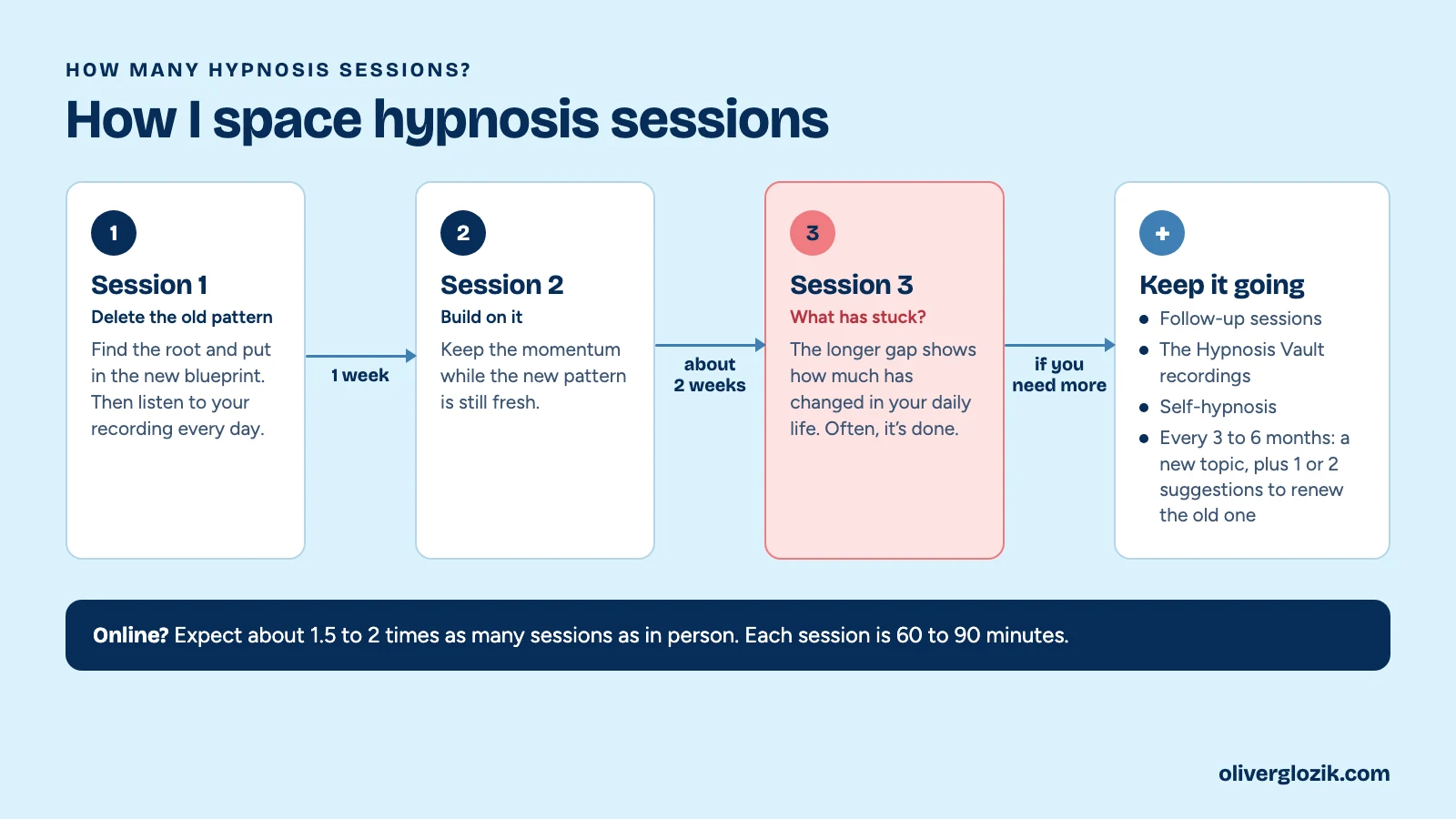
The first week keeps the momentum going while the new pattern is still fresh. The longer gap before the third session is on purpose: it shows us how much of the change has stuck in your daily life. Sometimes the answer is that it’s done. If there’s still something to work on, we can see exactly what.
If you need more after that, there are follow-up sessions. You also get access to my Hypnosis Vault, a library of hypnosis recordings, and you learn self-hypnosis, so you can keep reinforcing the change on your own.
Follow-up sessions every three to six months
Many of my clients come back for a session every three to six months, and often it’s not about the same topic. Once people see how effective hypnosis is, they want to use it for other areas of their life as well.
In those sessions I can always add one or two suggestions around the earlier topic to renew it. For example, if we worked on weight before, I might add a suggestion like “you have a fit and healthy body”. For something like smoking, there’s no need: if you’ve already stopped, I don’t bring it back up.
When is the work done?
The work is done when the old program has been deleted, the new one has been installed, and you can see it working in your daily life.
That’s the only real measure. Not the number of sessions you’ve booked, and not how many times you’ve talked about the topic. Once the new pattern is accepted and you’re living it, you don’t need to keep revisiting a topic that deep down you have already accepted and that is working.
I see that people can get caught in loops here. They decide they need one more session, and one more after that, even when the change has already happened. In a way, telling yourself that you need more and more sessions is a form of self-sabotage. It keeps the old story alive: I’m still someone who has this problem.
“It takes as long as your subconscious mind needs to delete the old blueprint and accept the new one as your reality, so that you act on it. Surprisingly, this can happen in one session. Sometimes more are needed.”
 Oliver GlozikHypnotist, breathwork facilitator and coach
What decides how many sessions you need
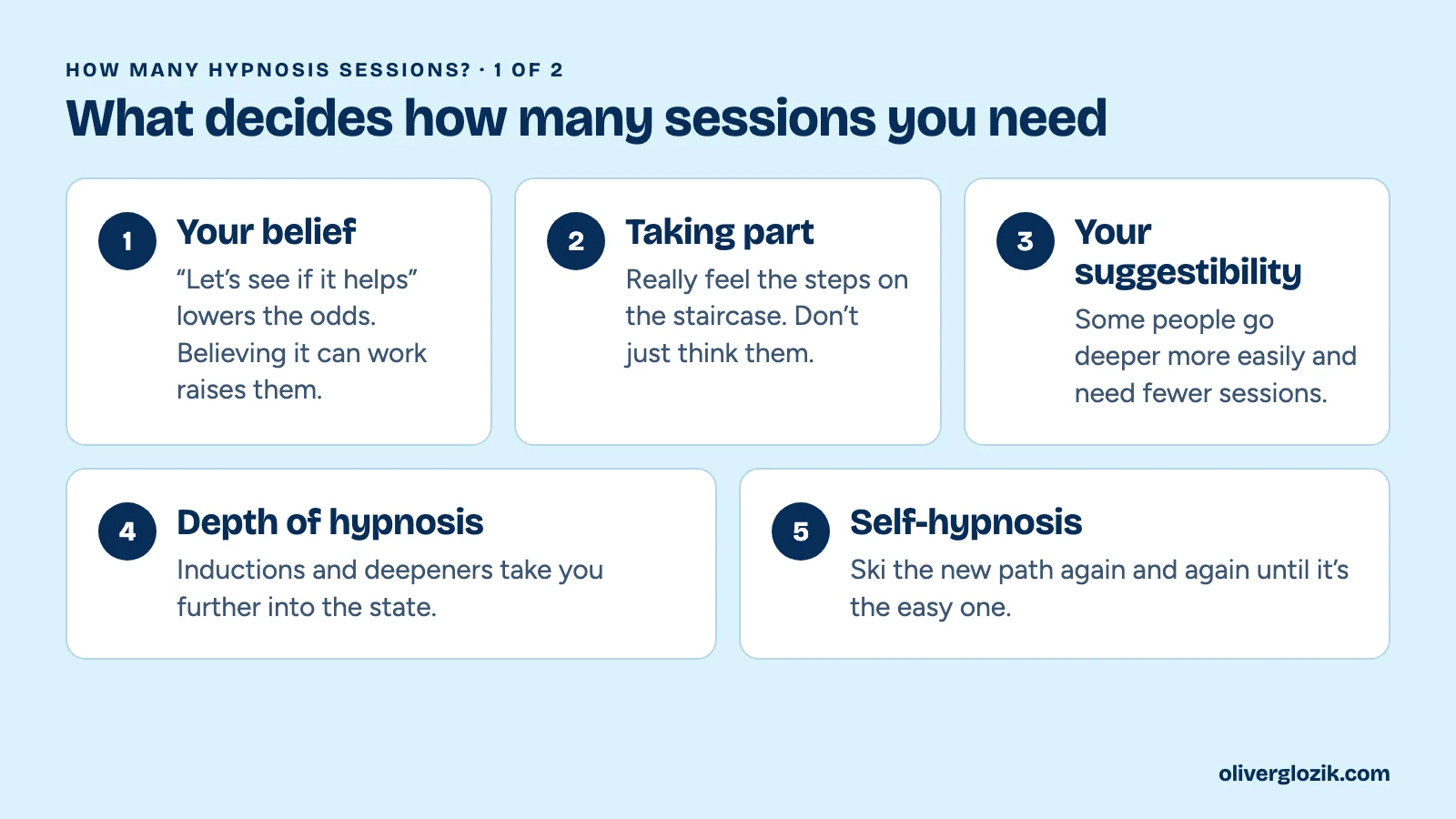
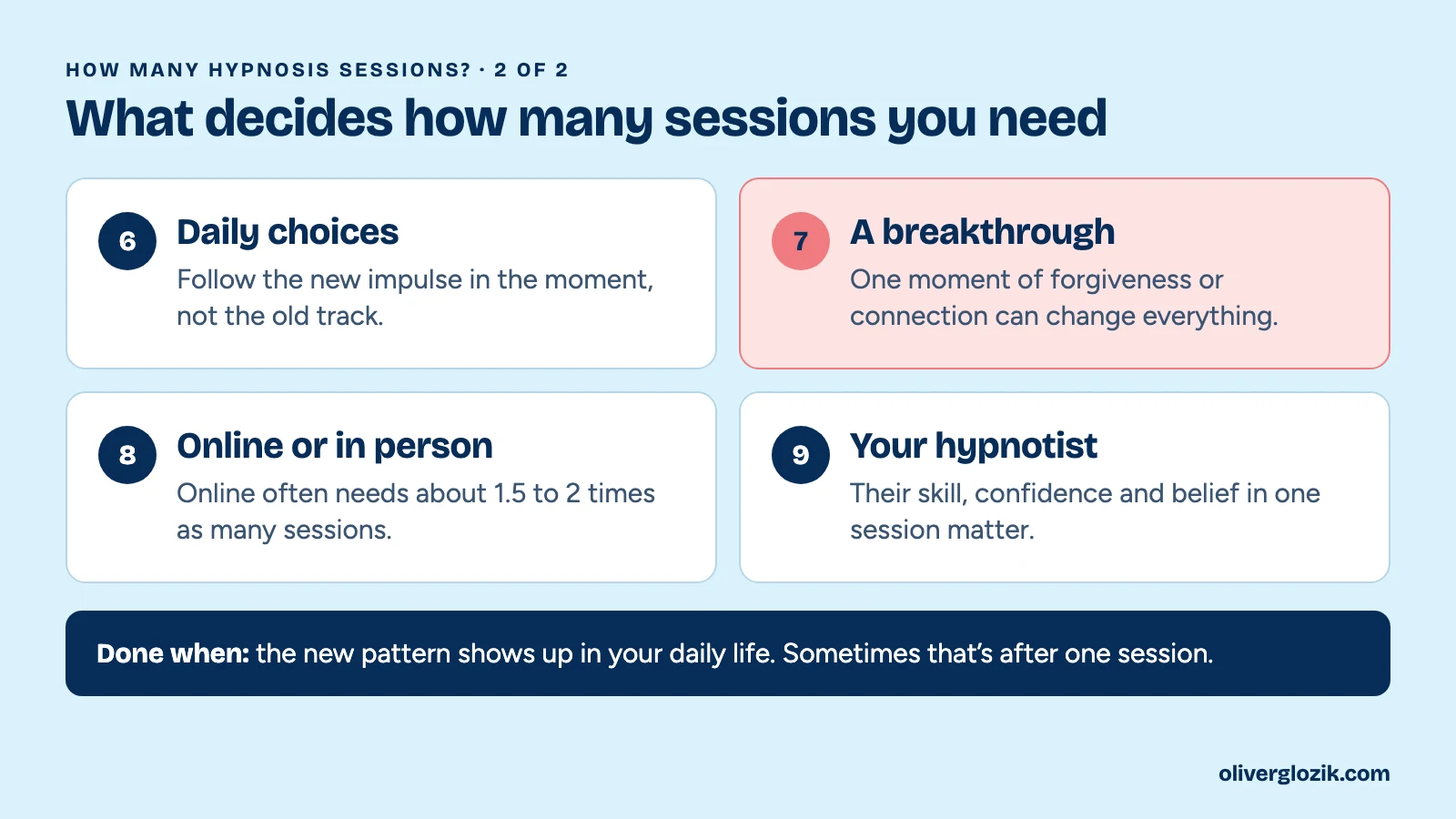
The number of sessions depends on your belief, how hypnotisable you are, how deep the hypnosis goes, what you do between sessions, whether a breakthrough happens, and the skill of your hypnotist. Here is each one.
1. What you believe and how seriously you take it
It takes as many sessions as you believe, and as many as your hypnotist believes.
If you come into a session thinking, “I’ll try it and see. Maybe it helps, maybe not,” the chances are lower. Not zero, but lower. If you believe hypnosis can make a difference for you, and especially if you have met people it helped with your kind of problem, your belief is a lot higher, and so is the effect.
Research supports this. Psychologist Irving Kirsch spent decades studying what he called response expectancy: what you expect to happen strongly shapes how you respond to hypnotic suggestions (Kirsch, 1985). Researchers still debate exactly how big that effect is, but expectation clearly plays a part (Cardeña, 2019).
2. Taking part, not just listening
Hypnosis is a two-way street. The more you put yourself into it, the more powerful the session becomes.
When I guide you down a spiral staircase during the induction, you can just think, “Okay, I’m going down a staircase.” Or you can really put yourself there: feel your feet on the steps, one after the other. The second one makes the whole session that much more powerful, and a more powerful session can mean fewer sessions.
3. How easy you are to hypnotise
Some people are significantly easier to hypnotise than others, and they can usually go deeper and need fewer sessions.
This is one of the best-studied facts about hypnosis. How responsive someone is to hypnosis is a fairly stable trait: in a Stanford study, people tested as students and again 25 years later scored remarkably similarly (Piccione, Hilgard & Zimbardo, 1989). A large review of hypnosis trials also found that more responsive people tended to get better results (Flammer & Bongartz, 2003).
If you’re less responsive, don’t worry. Hypnosis can still work for you. It may just take a little more time, and your belief and participation (points 1 and 2) still count.
4. How deep the hypnosis goes
Depth is related to how hypnotisable you are, but it’s also a separate thing: it depends on how many inductions and deepeners the hypnotist uses, and how deep they’re able to take you. A deeper state lets us work more directly with the subconscious, so the change can happen faster.
5. Self-hypnosis between sessions
Learning self-hypnosis helps you keep reinforcing the new pattern, and it gives the power back to you.
I like to compare it to skiing down a mountain. You have a habitual track that you’ve been taking for years. A hypnosis session is like fresh snow falling: suddenly you can take a new path down the mountain. The more often you take that new path, the deeper it gets. Listening to your recording and practising self-hypnosis is skiing the new path again and again. If you want to try it, I explain how in how to hypnotize yourself.
6. Following the new impulse in daily life
Hypnosis creates awareness and distance from your old habits, but in the moment itself, the choice is still yours.
Say you’re a workaholic, and in the session we set a new, healthy time to stop working. Then 5 o’clock comes, or 8 o’clock, whatever your time is, and you feel the impulse: “Okay, I’m going to close the laptop.” If you follow it, you’re creating the new path down the mountain. If you ignore it and go down the familiar way, the old track is still there under the fresh snow, and you’ll end up on it again.
That’s a level of self-responsibility every person needs to take for their own life. Change happens in those moments of awareness, when you step back and consciously choose the new way instead of falling into the habitual way of thinking and acting.
7. A breakthrough moment
Sometimes one moment in a session changes everything, and then one session can be enough.
Most of us have experienced how life can change from one moment to the next. Unfortunately, most people know it from the painful side. You’re in a relationship for five years, the other person breaks up with you, and from one day to the next your life is different. Even the way you treat yourself and others can change.
It works the other way too. Many people can’t say “I love you” to their mother or father. Without anything changing, three or six months from now they will be in exactly the same spot. But if in a hypnosis session they reach a breakthrough, when they accept certain things, forgive, and really feel that forgiveness, the love and the connection to themselves and to that parent, it can change their life tremendously. Whether a breakthrough like that is available is one of the things that decides the number of sessions.
8. Online or in person
In person, I can usually go significantly deeper. Online sessions are still powerful, but in my experience they generally need about 1.5 to 2 times as many sessions.
When we’re in the same room, there’s more presence, and I pick up on more details. That makes the session more powerful. Most of my sessions are still online, and they work well. Just expect that you might need a few more sessions than you would in person.
9. The skill of your hypnotist
The expertise, confidence and practical skill of your hypnotist make a big difference to how well it works and how many sessions you need.
A hypnotist with a lot of limiting beliefs of their own will, in a way, pass those on to you. If they don’t believe one session can be enough, it probably won’t be. So it’s worth choosing someone experienced who you trust.
Is more sessions better?
No. Research suggests that a shorter, focused course of hypnosis can work as well as a longer one.
The best study on this question was done in Manchester, UK. Researchers gave 448 people either six or twelve sessions of hypnotherapy for a long-term gut problem. After six sessions, 78.8% of people had improved, compared with 73.9% after twelve, so the shorter course was at least as good (Hasan et al., 2021). It’s one study in one area, but it fits what I see: once the change has happened, more sessions don’t add much.
The same goes for single sessions. In a small study on smoking, people who had just one hypnosis session smoked less, and more of them had stopped, than people in placebo and no-treatment groups, up to almost a year later (Williams & Hall, 1988). Larger reviews say the evidence on smoking is still uncertain (Barnes et al., 2019), so I won’t promise anyone one session. But it can happen.
What about “93% success after six sessions”?
You’ll see this number on a lot of hypnotherapy websites, but I don’t rely on it.
It comes from a 1970 review by Alfred Barrios that compared hypnotherapy with other therapies (Barrios, 1970). It’s an average across older, small reports where “recovery” was measured in very different ways, not a controlled trial. It’s interesting history, but not a reliable promise of how many sessions you’ll need or what your results will be.
Is hypnosis safe?
Hypnosis is safe for most people. If you have a history of psychosis, schizophrenia, bipolar disorder or epilepsy, please talk to me before you book. Hypnosis is not a replacement for medical or psychological care, and I don’t make medical claims about it. If you are in crisis, contact your local emergency services.
If you’d like to work with me, I offer hypnosis as a package of 3 sessions. Have a look at how hypnosis with me works.
Questions about the number of hypnosis sessions
Can one hypnosis session be enough?
Yes, for some people it is, especially for one clear habit or when a breakthrough moment happens in the session. Stay open to it.
Why do some people need more sessions?
Usually because the pattern has several roots, they’re less easy to hypnotise, they don’t fully take part in the session, or they keep following the old impulse in daily life.
How do I know when I don’t need another session?
When the new pattern shows up in your daily life without you having to force it. If it’s working, you don’t need to keep going back to it.
Do online sessions need more sessions?
In my experience, often a little more, about 1.5 to 2 times as many as in person. Online sessions still work well.
How far apart should hypnosis sessions be?
With me, the first two sessions are one week apart, and the third is about two weeks after the second, so we can see how much of the change has stuck.
What if I need more than three sessions?
Then we add follow-up sessions. You also have the Hypnosis Vault recordings and self-hypnosis to keep reinforcing the change between sessions.
Do I need follow-up sessions later on?
Not necessarily. Many people come back every three to six months, often for a different area of their life, and I add one or two suggestions to renew the earlier change when it helps.
What should I do between sessions?
Listen to your recording in the morning and evening, practise self-hypnosis, and follow the new impulse when it comes up in your day.
Is it a bad sign if I need more than one session?
No. Everyone is different. What matters is that the change happens, not how fast.
References
- Kirsch, I. (1985). Response expectancy as a determinant of experience and behavior. American Psychologist, 40(11), 1189 to 1202. https://doi.org/10.1037/0003-066X.40.11.1189
- Cardeña, E. (2019). Hypnosis research: expectancies and beyond (review). International Journal of Clinical and Experimental Hypnosis. Full text (PDF), Goldsmiths
- Piccione, C., Hilgard, E. R. & Zimbardo, P. G. (1989). On the degree of stability of measured hypnotizability over a 25-year period. Journal of Personality and Social Psychology, 56(2), 289 to 295. https://doi.org/10.1037/0022-3514.56.2.289
- Flammer, E. & Bongartz, W. (2003). On the efficacy of hypnosis: a meta-analytic study. Contemporary Hypnosis, 20(4), 179 to 197. Record, Epistemonikos
- Hasan, S. S., Whorwell, P. J., Miller, V., Morris, J. & Vasant, D. H. (2021). Six vs 12 sessions of gut-focused hypnotherapy for irritable bowel syndrome: a randomized trial. Gastroenterology, 160(7), 2605 to 2607. https://doi.org/10.1053/j.gastro.2021.02.058
- Williams, J. M. & Hall, D. W. (1988). Use of single session hypnosis for smoking cessation. Addictive Behaviors, 13(2), 205 to 208. https://pubmed.ncbi.nlm.nih.gov/3369332/
- Barnes, J., McRobbie, H., Dong, C. Y., Walker, N. & Hartmann-Boyce, J. (2019). Hypnotherapy for smoking cessation. Cochrane Database of Systematic Reviews, CD001008. https://doi.org/10.1002/14651858.CD001008.pub3
- Barrios, A. A. (1970). Hypnotherapy: a reappraisal. Psychotherapy: Theory, Research & Practice, 7(1), 2 to 7. https://doi.org/10.1037/h0086544
Want to try it for yourself?
See how my hypnosis sessions work, or book a free call and ask me anything first.