How do you hypnotize yourself? Sit comfortably, look up, take three deep sighs and close your eyes. Then take yourself deeper with an image, give yourself vivid suggestions, and count yourself back up. That’s self-hypnosis in one sentence.
The steps are simple. What makes it work is practice, a clear picture of what you want, and how much you believe in it. A review of 22 trials found self-hypnosis worked best when people learned it as their own skill and practised it, and least when they only listened to someone else’s recording.
I use it myself. Once I hypnotized myself for financial abundance, and within a week I made 7,000 USD. The hypnosis didn’t bring the money by itself. The key was acting on the impulse I felt afterwards. Instead of following my normal patterns, I used the energy that was freed up in the session to do outreach and offer my products.
That’s my experience, not a promise. But it shows what self-hypnosis is best at: changing your inner state so you act differently.
Key points: how to hypnotize yourself
- Yes, you can hypnotize yourself. In self-hypnosis you lead yourself into the same state of relaxed concentration a hypnotist would lead you into.
- The hardest part is being both hypnotist and client. You lead and receive at the same time. Recording your own session can help.
- Detail is everything. The more vivid your inner pictures and the more you feel them, the stronger the suggestion.
- Confidence matters. If you’re very anxious or unsure, a session with a hypnotist first can help.
- Practise daily. I ask people to commit to 21 days.
- You can’t get stuck. If you do nothing, you simply come out of it, or drift into sleep.
- Leave old memories to a session. Working through the past is easier with someone guiding you.
Can you really hypnotize yourself?
Yes. Self-hypnosis uses the same state as being hypnotized by someone else. You just guide yourself into it.
I learned self-hypnosis through hypnosis itself: through my courses and certifications, and then realising I could use the same principles on myself. I now use it in moments of silence instead of meditating, because it simply works better for me. (I explain the difference in hypnosis vs meditation.)
There is one honest challenge. When I hypnotize a client, I’m in the active role. I lead, and the other person is passive and receives. In self-hypnosis you do both. You lead yourself where you want to go, and at the same time you have to let go and receive it. Active and passive at once.
Researchers noticed the same thing. In a 1981 study, people learning self-hypnosis reported “a good deal of anxiety and self-doubt” at first, until they adapted to the state. They also found imagery much richer than when someone else hypnotized them (Fromm et al., 1981). So if your first tries feel awkward, that’s normal.
Before you start
Choose one goal, write down your suggestions, and find 10 to 20 minutes where nobody will disturb you.
- One goal per session. For example: feeling confident before a presentation, a calm inner state, or seeing yourself as the person you want to become.
- Your suggestions, written down. Two or three sentences you’ll say to yourself. I explain how to word them below.
- A chair. Sit rather than lie down, so you stay in hypnosis rather than falling asleep.
- Not while driving or doing anything that needs your attention.
How to hypnotize yourself in 7 steps
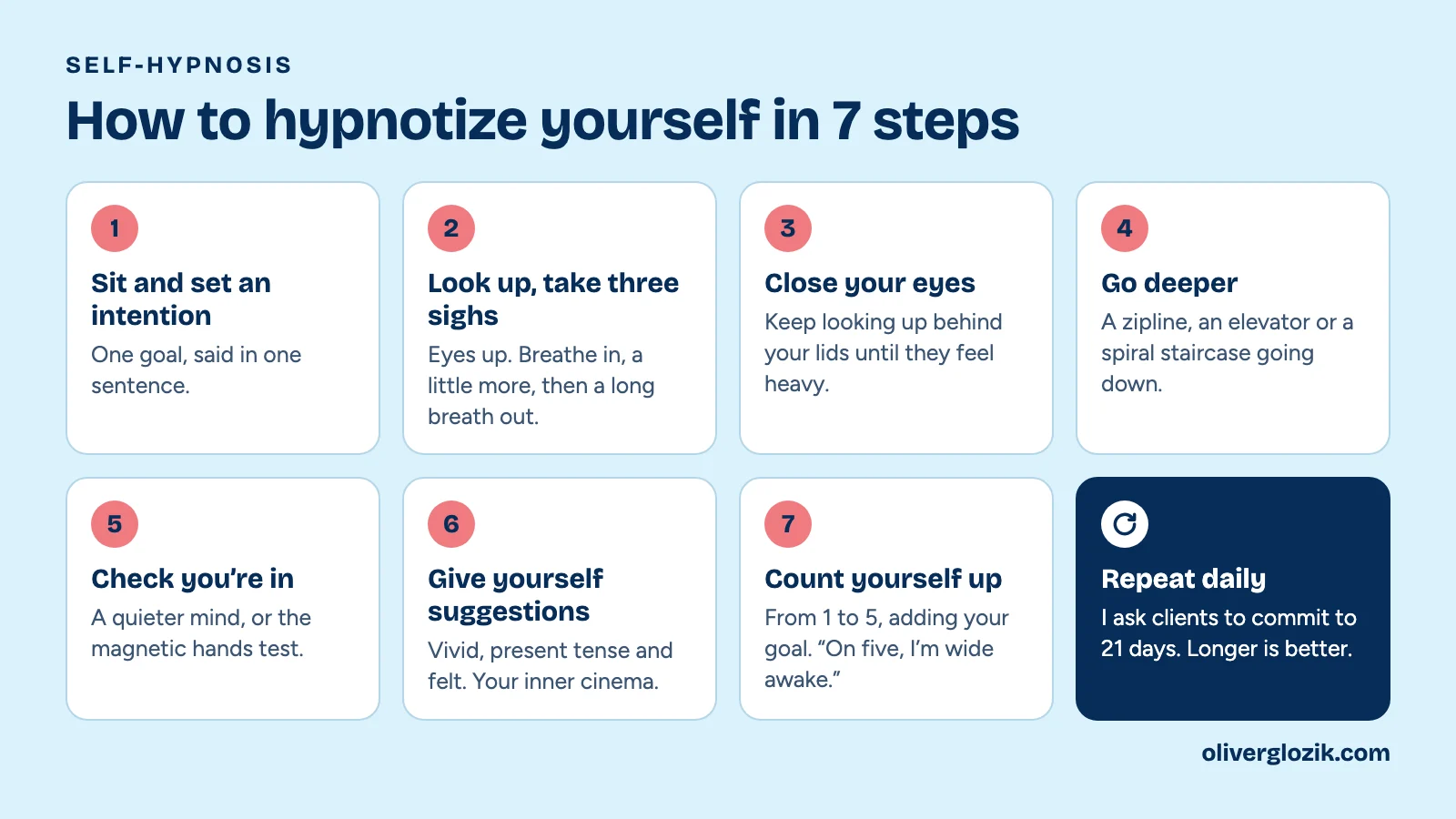
1. Sit comfortably and set your intention
Sit comfortably with your feet on the floor and your hands in your lap. Then say your intention to yourself in one sentence, for example: “I’m here to feel confident and calm for tomorrow’s meeting.” It tells your subconscious mind where you’re going.
2. Look up and take three deep sighs
The induction is the most important part of hypnosis. It’s how you get yourself into the state. The one I like most, which I learned in my training with Marissa Peer, starts with your eyes.
Look upwards with your eyes, as if you’re looking at your eyebrows, without moving your head, and hold it. Then take three deep sighs. For each one, breathe in deeply, add a little more air on top, and let it all go in a long, slow breath out. This double inhale is called the physiological sigh, and it’s one of the quickest ways to calm the body.
3. Close your eyes while still looking up
Let your eyelids close, but keep your eyes looking upwards behind them. Holding that position tires the eye muscles, and you’ll notice your eyelids getting heavy and yourself getting more and more tired. Let that heaviness spread. That’s the start of the hypnotic state.
4. Take yourself deeper
Now give your mind an image of going down. I use one of three:
- A zipline that carries you deeper and deeper into your subconscious.
- An elevator going further and further down, floor by floor.
- A spiral staircase, where with every step you take, you go deeper and deeper.
You can count down as you go, from 10 to 1, saying “deeper” with each number. Use whichever image feels natural, and keep the same one, so your mind learns the way in.
5. Check that you’re in
At this point I’m experienced enough to know when I’m in hypnosis and when I’m not. The main sign is how active my mind is. If I’m thinking left, right and in all directions, I’m not there yet. When my thoughts slow down and go quiet, I am.
If you want a test, try the magnetic hands. Hold your hands out in front of you, palms facing each other, a little apart. Imagine a strong magnet between them, and tell yourself: “The magnet is pulling my hands closer and closer.” Then notice how your body responds. Any movement counts, even a small one. It isn’t a pass or fail, just your body responding to your own suggestions.
6. Give yourself suggestions
Now repeat your written suggestions slowly, and picture yourself already there: what you see, hear and feel. Stay with it for a few minutes. I explain how to word them below.
7. Count yourself up
Even if you do nothing, you will come out of hypnosis by yourself. You can’t get stuck. But it’s more powerful to end on a clear note, so it has a start and a finish and doesn’t just drift off. It closes the loop.
Just as you went down, count yourself up, from 1 to 5, or from 1 to 10 after a deep session. Add your intention to the counting: “With every number I become more and more confident. On the count of five I’m wide awake, confident, and living in that new reality.” Then open your eyes.
Then act on it. The impulse you feel right after a session is the most valuable part. Use that energy for the step you’d normally put off, before your old patterns take over again.
“In self-hypnosis you are leading yourself where you want to go and receiving it at the same time. The more vivid the picture you create, the stronger the hypnosis.”
 Oliver GlozikHypnotist, breathwork facilitator and coach
How to word your self-hypnosis suggestions
Make your suggestions vivid, detailed, emotional and in the present tense, and repeat them.
Your mind and body respond to a vividly imagined scene in many of the same ways as to a real one. Brain imaging shows that imagined and seen images use overlapping areas, down to the primary visual cortex, and an imagined bright light even makes your pupils narrow (Pearson et al., 2015). That’s why detail matters.
So the more descriptive you are, the better. Use strong words such as phenomenal and extraordinary. Use all your senses, so you’re in the picture you’re creating rather than watching it from far away. I think of it as your own inner cinema.
A few rules I use:
- Present tense. “I am calm and confident when I speak”, not “I will be confident one day”.
- Say what you want, not what you don’t want. “I breathe slowly and feel steady”, not “I’m not nervous”.
- Make it believable to you. A study found that people with low self-esteem who repeated “I’m a lovable person” felt worse afterwards, not better (Wood et al., 2009). If a sentence feels like a lie, choose a smaller step you can believe, or picture a scene instead of making a claim.
- Add feeling. Notice the pride, the calm or the relief as if it’s already happening.
- Repeat it. Several times in a session, and every day.
Some images I use myself: a healing ball of warm energy flowing through my body, seeing myself succeed at a specific goal, or stepping into the confident person I want to become and feeling how they stand and breathe.
Asking your subconscious yes-or-no questions
Once you’re in self-hypnosis, you can set up a body signal for “yes” and one for “no”, and then ask yourself simple questions.
Ask your subconscious mind to give you a clear signal for “yes”, such as a twitch in one finger or a feeling somewhere in your body, and wait until you notice it. Then ask for a signal for “no”. Once both are clear, you have a kind of inner calibration. Now ask a yes-or-no question and notice which signal comes. It’s a way to find out what you really resonate with.
Hypnotherapists have used signals like this since the 1950s, under the name ideomotor signals. Hold the answers lightly, though. These are small, unconscious muscle movements, and what you expect or hope can move them too. No research shows they reveal a hidden truth. I use them to listen to my gut feeling, not as an oracle. Don’t use them to decide on health or money matters, or to find out whether something happened in your past.
Can you make your own self-hypnosis recording?
Yes, and it solves the hardest part of self-hypnosis: leading and receiving at the same time.
This is what I do. Whatever topic I want to work on, I record a hypnosis of about 10 minutes, with the induction, the deepener, my suggestions and the count up. Then I listen to it, and I can surrender to it much more easily, because I no longer have to lead.
One honest nuance: in the research below, recordings of someone else’s hypnosis did least well. A recording you write and record yourself is different, because you still choose the goal and the words, but no study I found tests that directly. So keep practising the steps on your own too.
Does self-hypnosis work?
The research is encouraging, especially for pain, stress and anxiety, but the studies are small.
The best summary is a 2019 review that found 22 randomised controlled trials of self-hypnosis, covering pain, childbirth, stress, anxiety and children’s health. Overall it found a medium-to-large effect (Eason & Parris, 2019). Two findings stood out:
- Self-hypnosis worked best when it was taught as an independent, self-directed skill, with at least three practice sessions before the trial.
- The studies that found no effect usually gave people only audio recordings of someone else’s hypnosis.
Keep the limits in mind. The trials were small and varied a lot. In all of them, a hypnotist taught people first, so we don’t know how well self-hypnosis works for someone who learns it alone from an article.
Belief matters too. In one study of suggestibility, what people expected to happen was the only factor that still predicted how they responded once imagination, fantasy proneness and motivation were taken into account (Braffman & Kirsch, 1999). That matches what I see. The effectiveness of self-hypnosis comes down to your belief, your conviction and your active imagination.
Why self-hypnosis sometimes does nothing
The most common reasons are low confidence, the struggle to lead and receive at once, and too little practice.
The most common beginner mistake I see is a lack of confidence. If you try self-hypnosis while you feel nervous and uncertain, and then decide “this didn’t work for me”, you may lose a tool that would have worked in a different setting.
So for someone very anxious or unsure of themselves, self-hypnosis may not be the best first step. A skilled hypnotist can build that belief first. You see that you respond, you borrow the confidence from somebody else, and then you can do it yourself. That’s also how the studies above taught it.
Repetition matters as well. I ask clients to commit to 21 days, and the longer the better. Twenty-one isn’t a magic number: a well-known habit study found a new daily habit took a median of 66 days to feel automatic, ranging from 18 to 254 (Lally et al., 2010). But 21 days is long enough to feel a difference and to build the practice.
And if you’ve practised for months and feel no change at all, something in the method needs adjusting. A hypnotist can usually spot what’s missing.
Benefits of self-hypnosis, and when to see a hypnotist
Self-hypnosis can ease pain, stress and anxiety, and it’s a great tool for confidence, inner calm and becoming the person you want to be. For old memories, it’s easier to work with someone else.
The benefits with the most research behind them are less pain, including during childbirth, and lower stress and anxiety (see the research above). I teach my clients self-hypnosis, because it’s good to become your own guide, your own hypnotist and your own coach. In my experience, it works well for:
- Confidence and self-image: who you want to become.
- Your inner state: calm, focus and control of your reactions.
- Visualising a goal or a success you’re working towards.
- Relaxation and winding down before sleep.
- Supporting habit change, alongside work on the cause, for example with weight loss or anxiety.
- Checking in with yourself: finding out what you really resonate with, using yes-or-no body signals.
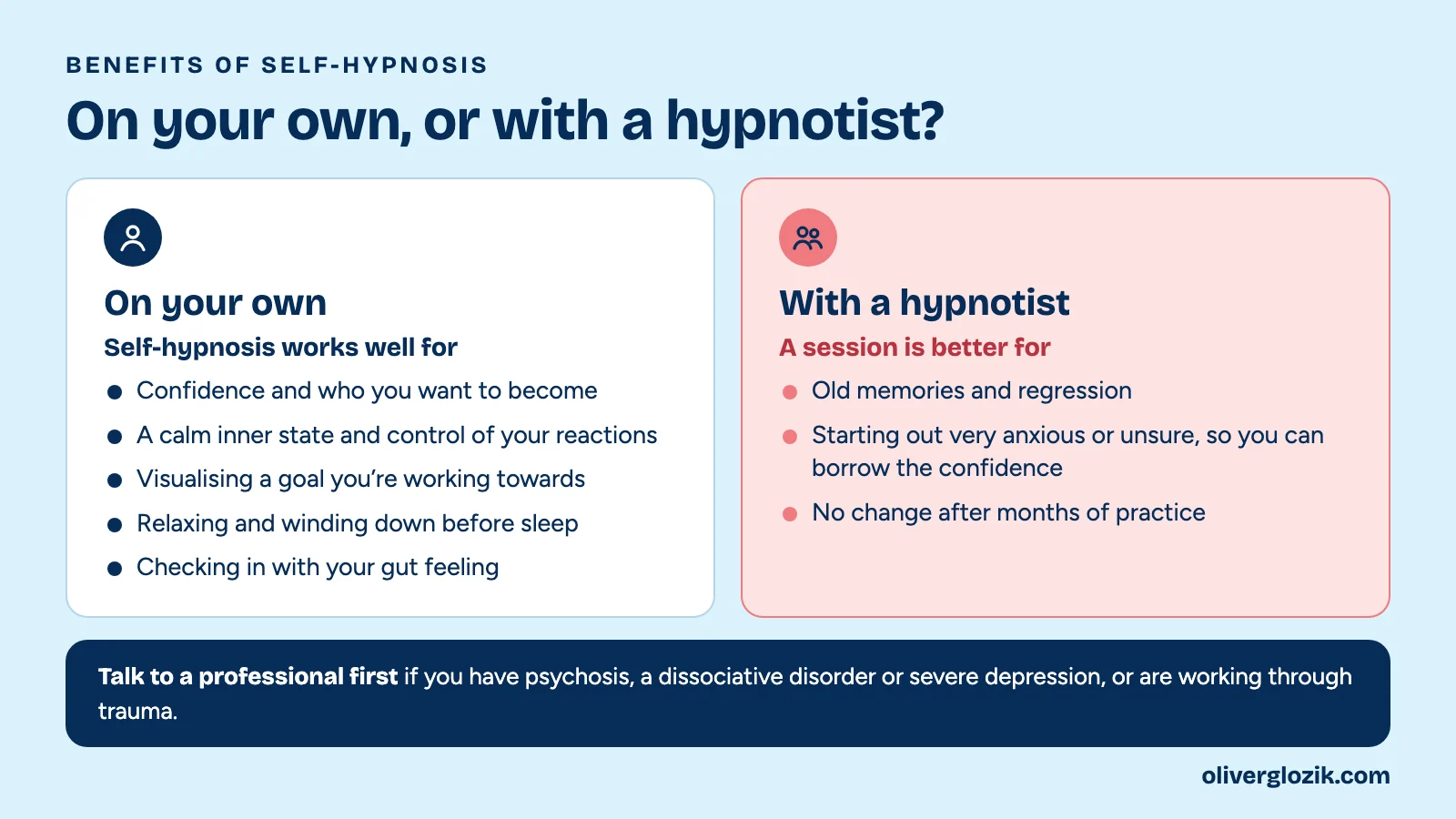
Where I’d use a session instead is regression, working with past memories. In my sessions I might say, “On the count of three, a memory comes up connected to this feeling.” I’ve tried that technique on myself in self-hypnosis, and I found it very difficult. When the work is about the past, it’s better to receive the hypnosis from someone else, live, over video, or through a recording made for you.
My clients also get access to my Hypnosis Vault, a library of hypnosis recordings to follow along with. There are real benefits to simply receiving, and to learning to do it yourself. If you’d like help with either, see how my hypnosis sessions work.
Is self-hypnosis dangerous?
For most people, no. You can’t get stuck, and serious side effects from hypnosis are rare. Some people should use a professional instead of doing it alone.
An analysis of registered clinical trials using hypnosis found no serious adverse events attributed to it, and other adverse events in 0.47% of participants (Bollinger, 2018). Those trials were medical, and many didn’t report side effects at all. An older review found that mild effects such as a headache, dizziness or anxiety can happen and usually pass quickly, while rarer, stronger reactions mostly involved painful memories during age regression (Gruzelier, 2000). That’s another reason to leave regression to a session.
Please don’t do self-hypnosis alone, and talk to a professional first, if you have a history of psychosis or schizophrenia, a dissociative disorder, severe depression, or if you’re working through trauma. If you have epilepsy, check with your doctor. Self-hypnosis doesn’t replace medical or psychological care. If you feel unsettled afterwards, stop and talk to someone you trust. Read more in will I lose control during hypnosis.
Questions about self-hypnosis
How long should a self-hypnosis session be?
About 10 to 20 minutes is plenty. My own recordings are about 10 minutes.
What’s the best time of day for self-hypnosis?
Whenever you can be undisturbed. Morning sets you up for the day. Evening works well too, but if you’re tired you may fall asleep.
What if I fall asleep during self-hypnosis?
Nothing bad happens. You simply wake up as you would from a nap. If it keeps happening, sit upright and practise earlier in the day.
Can I hypnotize myself without a recording?
Yes. You go through the steps in your head. The more you can visualise it, the more you put yourself into that state, with your own inner cinema going on.
References
- Eason, A. D. & Parris, B. A. (2019). Clinical applications of self-hypnosis: a systematic review and meta-analysis of randomized controlled trials. Psychology of Consciousness: Theory, Research, and Practice, 6(3), 262 to 278. https://doi.org/10.1037/cns0000173
- Fromm, E., Brown, D. P., Hurt, S. W., Oberlander, J. Z., Boxer, A. M. & Pfeifer, G. (1981). The phenomena and characteristics of self-hypnosis. International Journal of Clinical and Experimental Hypnosis, 29(3), 189 to 246. https://doi.org/10.1080/00207148108409158
- Pearson, J., Naselaris, T., Holmes, E. A. & Kosslyn, S. M. (2015). Mental imagery: functional mechanisms and clinical applications. Trends in Cognitive Sciences, 19(10), 590 to 602. https://doi.org/10.1016/j.tics.2015.08.003
- Wood, J. V., Perunovic, W. Q. E. & Lee, J. W. (2009). Positive self-statements: power for some, peril for others. Psychological Science, 20(7), 860 to 866. https://doi.org/10.1111/j.1467-9280.2009.02370.x
- Braffman, W. & Kirsch, I. (1999). Imaginative suggestibility and hypnotizability: an empirical analysis. Journal of Personality and Social Psychology, 77(3), 578 to 587. https://doi.org/10.1037/0022-3514.77.3.578
- Lally, P., van Jaarsveld, C. H. M., Potts, H. W. W. & Wardle, J. (2010). How are habits formed: modelling habit formation in the real world. European Journal of Social Psychology, 40(6), 998 to 1009. https://doi.org/10.1002/ejsp.674
- Bollinger, J. W. (2018). The rate of adverse events related to hypnosis during clinical trials. American Journal of Clinical Hypnosis, 60(4), 357 to 366. https://doi.org/10.1080/00029157.2017.1315927
- Gruzelier, J. (2000). Unwanted effects of hypnosis: a review of the evidence and its implications. Contemporary Hypnosis, 17(4), 163 to 193. https://doi.org/10.1002/ch.207
Want to try it for yourself?
See how my hypnosis sessions work, or book a free call and ask me anything first.