What is bee breath? Bee breath is a slow breath out through the nose while you hum with your lips closed, like the buzz of a bee. In yoga it’s called Bhramari pranayama, from the Sanskrit word for bee.
You breathe in through your nose, then let the breath out as a long, steady “mmm”. Many people also close their ears with their fingers, so the hum fills the inside of the head.
I reach for humming when I’m really, really stressed and I’m on my own. It’s a little like the physiological sigh for me: a quick way to switch from one state into another. In this post I explain how to do it, what happens in your body, and what the research does and doesn’t show.
Bee breath at a glance
- The pattern: a calm inhale through the nose, then a long exhale through the nose with a steady hum, lips closed.
- How long: 5 to 10 rounds, or a few minutes. Longer once it feels easy.
- What people use it for: calming down when stressed, settling the mind before meditation or sleep.
- The research: small studies link it with a calmer heart rhythm and a small drop in blood pressure in the moment. A review calls the evidence low quality so far.
- Why I like it: you feel it straight away. The vibration gives your mind something to hold on to.
How to do bee breath, step by step
Sit up straight, breathe in through your nose, then hum a long, soft “mmm” on the way out until your breath runs out.
- Sit comfortably with a straight back. On a chair or on the floor. Yoga teachers advise against doing it lying down.
- Close your eyes and let your shoulders and jaw soften.
- Close your ears (optional). Rest your index fingers on the small flap of cartilage in front of each ear canal and press it gently closed. No need to push into the ear.
- Breathe in slowly through your nose, for about 3 to 4 seconds.
- Hum on the exhale. Keep your lips together and your teeth slightly apart, and make a low, even “mmm” for as long as the breath lasts comfortably, often 6 to 10 seconds. Feel the buzz in your face, head and chest.
- Repeat 5 to 10 times. Then lower your hands, sit quietly for a moment and notice how you feel.
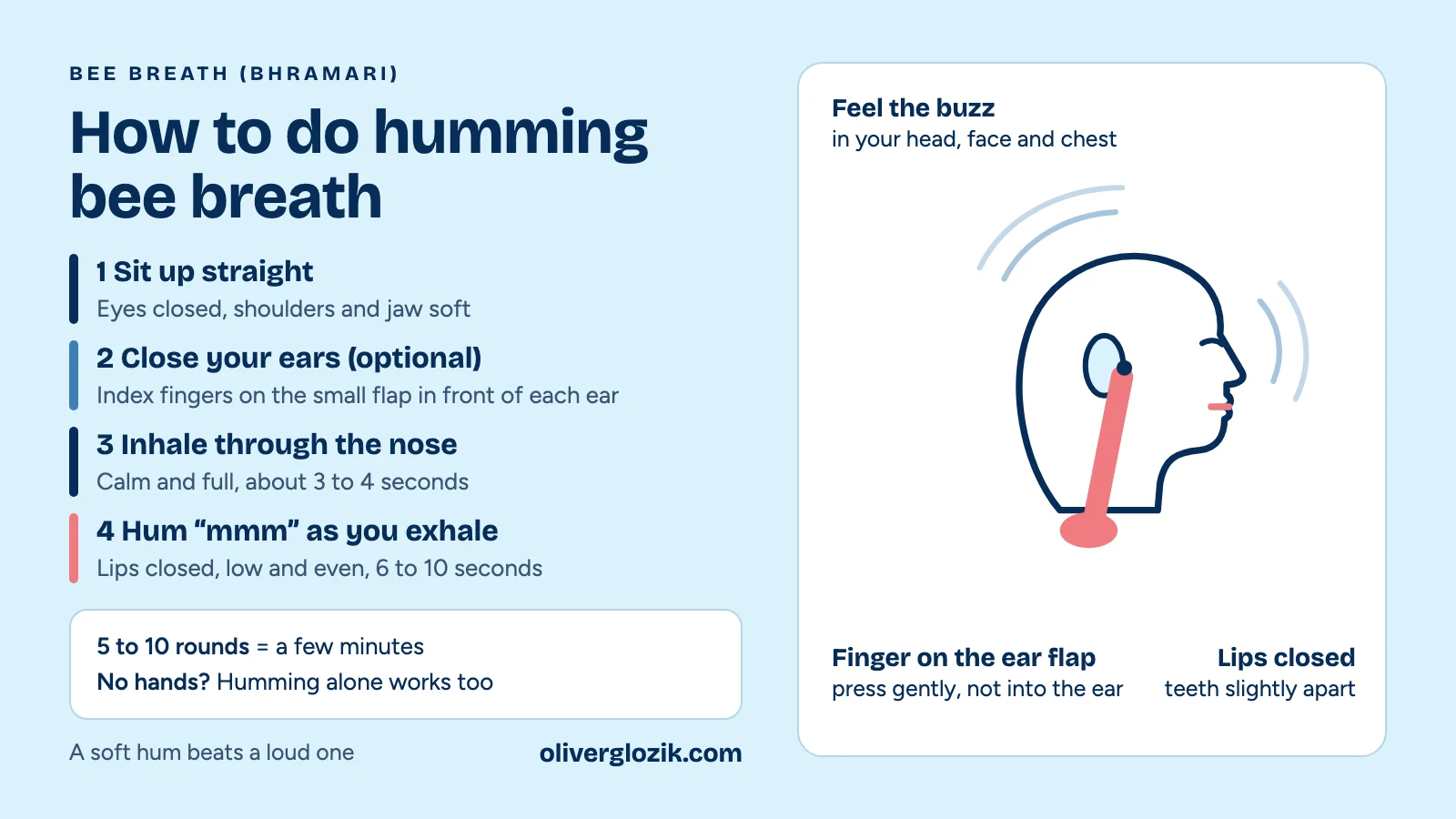
Keep it gentle. A quiet, low hum works better than a loud one, because you want to feel the vibration, not strain your throat. If you’re somewhere you can’t close your ears, hum without your hands. The 2023 study further down did exactly that.
Where the name comes from
“Bhramari” comes from bhramara, the Sanskrit word for a bee. The hum on the out-breath sounds like a bee buzzing. The practice is old: the Hatha Yoga Pradipika, a 15th-century yoga manual, lists it among its classic breathing practices and compares the sounds of the breath to buzzing bees.
In yoga, Bhramari is often taught as a way to turn your attention inwards. When your ears are closed, outside noise fades and the hum is all you hear. That’s also why yoga traditions suggest practising late in the evening or early in the morning, when it’s quiet.
“When I’m really, really stressed and there’s nobody around, that’s when I hum.”
 Oliver GlozikBreathwork facilitator, hypnotist and coach
How I use humming myself
I use it in high-stress moments when I’m on my own. In a meeting or on a train, people would look at me strangely, so that’s when I’d use a quiet physiological sigh instead. But when I’m alone and the stress is high, humming is the one I go to.
For me it works as a switch. Like the sigh, it moves me out of one state and into another, from wound-up to calmer. The long exhale slows everything down, and the vibration gives my mind something simple to focus on instead of whatever was stressing me.
What bee breath does in your body
The long, humming exhale slows your breathing down, and slow breathing with long exhales is linked to relaxation. Every time you breathe out, the vagus nerve, the main nerve of your rest-and-digest system, slows your heart down a little. A long exhale gives that slowing more time (Zaccaro et al., 2018). Humming makes a long exhale easy, because the sound naturally stretches it out.
Humming also changes the air in your nose. In a small 2002 study with 10 healthy people, the amount of nitric oxide in the nose rose about 15-fold during humming compared with breathing out quietly (Weitzberg & Lundberg, 2002). Nitric oxide is a gas your sinuses make, and the vibration of the hum moves air in and out of them much faster (Maniscalco et al., 2003). This happens in your nose and sinuses. You’ll read online that humming floods your whole body with nitric oxide, and these studies don’t show that.
What the research says about Bhramari
The studies are small, and most are low quality, but the direction is consistent: a calmer heart rhythm and a small drop in blood pressure during and right after practice.
- A review of the evidence. In 2017, researchers in India searched for every study of Bhramari and found only six that met their criteria. They reported effects on blood pressure, brain waves, reaction speed and tinnitus-related distress, but none of the six was a randomised trial, and they rated the overall quality as very low (Kuppusamy et al., 2017).
- Heart rhythm during humming. In a 2023 pilot study, 23 adults wore a heart monitor for a day. While they hummed (breathing in for 3 to 4 seconds and humming out for 6 to 8 seconds, no hands), their heart rate variability, a common sign of a relaxed nervous system, was higher and their stress index lower than during exercise or a stressful moment, and on some measures even than during sleep (Trivedi et al., 2023). It was small and had no control group, so treat it as an early signal.
- Blood pressure. In a 2023 trial with 100 people with high blood pressure, one 20-minute session of Bhramari lowered their blood pressure from an average of about 127/81 to 123/79 straight away (Upadhyay et al., 2023). That’s a single session, with no group that did nothing, and the patients were also getting other treatments in hospital. Whether regular practice lowers blood pressure over time hasn’t been tested well.
For comparison, across all types of breathwork, the biggest review so far found a small to medium effect on stress (Fincham et al., 2023). Bee breath fits that picture: a gentle, useful tool, with research that’s still catching up.
Benefits of humming bee breath
The best-supported benefits are feeling calmer, a slower heart rate and a small, short-term drop in blood pressure. Many people also use it before sleep or meditation because it quiets the mind.
You’ll find longer lists elsewhere: faster healing, a better voice, curing throat problems. I didn’t find studies that support those, so I’m not claiming them.
Bee breath vs other calming breaths
Bee breath gives your mind a sound to focus on; the others give it a count or a pattern.
| Technique | How you breathe | Often used for | Easy to do in public? |
|---|---|---|---|
| Bee breath (Bhramari) | In through the nose, long humming exhale | Calming down when stressed, before sleep or meditation | Not really, people hear it |
| Physiological sigh | Two inhales through the nose, one long exhale | A quick reset anywhere | Yes |
| Box breathing | In 4, hold 4, out 4, hold 4 | Regrounding and concentration | Yes |
| 4-7-8 breathing | In 4, hold 7, out 8 | Calming down, nerves, sleep | Yes |
For the bigger picture, including longer practices like conscious connected breathing, read what breathwork is and the main types.
Going further: adding a breath hold
Once the basic version feels easy, some yoga schools add a short pause with the lungs full before you start humming. You breathe in, gently tuck your chin and hold for a second or two, then lift your head and hum out. The idea is that the hum feels steadier after the pause.
This is optional, and beginners should skip it. Start with no more than one or two seconds and never strain. Skip breath holds completely if you have heart disease or high blood pressure, or if you’re pregnant.
Common mistakes
- Humming too loudly. A soft, low hum gives a stronger vibration than a forced one.
- Pressing too hard on the ears. Rest your fingers on the cartilage flap; don’t push into the ear canal.
- Rushing the inhale. Take a calm, full breath in, so you have enough air for a long hum.
- Clenching the jaw. Keep your lips together but your teeth slightly apart.
Is bee breath safe?
For most people, gentle humming is very safe. It has no fast breathing and, in its basic form, no breath holds. I didn’t find safety research specific to it, so this is cautious general advice drawn from yoga teaching.
- Don’t practise with an ear infection, and don’t press on your ears if they hurt.
- Sit upright rather than lying down.
- Skip breath holds if you have heart disease or high blood pressure, or are pregnant, and check with your doctor if you’re unsure.
- If you feel dizzy, stop and breathe normally.
Breathwork can support you, but it does not replace medical or psychological care.
Questions about bee breath
What is bee breath?
A slow exhale through the nose while humming with your lips closed. In yoga it’s called Bhramari pranayama.
Is bee breath the same as Bhramari pranayama?
Yes. Bee breath, humming bee breath and Bhramari are all names for the same practice.
How long should I do humming bee breath?
Start with 5 to 10 rounds, or two to three minutes. You can build up to longer sessions once it feels comfortable.
Do I have to close my ears?
No. Closing your ears makes the hum louder inside your head, but humming without your hands also works.
Is humming good for the vagus nerve?
A long, slow exhale is linked to more vagus nerve activity, and humming makes the exhale long. Small studies show a calmer heart rhythm during humming, but the evidence is still early.
References
- Kuppusamy, M., Kamaldeen, D., Pitani, R., Amaldas, J. & Shanmugam, P. (2017). Effects of Bhramari Pranayama on health – A systematic review. Journal of Traditional and Complementary Medicine, 8(1), 11 to 16. https://doi.org/10.1016/j.jtcme.2017.02.003
- Trivedi, G., Sharma, K., Saboo, B., Kathirvel, S., Konat, A., Zapadia, V., Prajapati, P. J., Benani, U., Patel, K. & Shah, S. (2023). Humming (Simple Bhramari Pranayama) as a stress buster: a Holter-based study to analyze heart rate variability (HRV) parameters during Bhramari, physical activity, emotional stress, and sleep. Cureus, 15(4), e37527. https://doi.org/10.7759/cureus.37527
- Upadhyay, J., Nandish, N. S., Shetty, S., Saoji, A. A. & Yadav, S. S. (2023). Effects of Nadishodhana and Bhramari Pranayama on heart rate variability, auditory reaction time, and blood pressure: a randomized clinical trial in hypertensive patients. Journal of Ayurveda and Integrative Medicine, 14(4), 100774. https://doi.org/10.1016/j.jaim.2023.100774
- Weitzberg, E. & Lundberg, J. O. (2002). Humming greatly increases nasal nitric oxide. American Journal of Respiratory and Critical Care Medicine, 166(2), 144 to 145. https://pubmed.ncbi.nlm.nih.gov/12119224/
- Maniscalco, M., Weitzberg, E., Sundberg, J., Sofia, M. & Lundberg, J. O. (2003). Assessment of nasal and sinus nitric oxide output using single-breath humming exhalations. European Respiratory Journal, 22(2), 323 to 329. https://pubmed.ncbi.nlm.nih.gov/12952268/
- Zaccaro, A., Piarulli, A., Laurino, M. et al. (2018). How breath-control can change your life: a systematic review on psycho-physiological correlates of slow breathing. Frontiers in Human Neuroscience, 12, 353. https://doi.org/10.3389/fnhum.2018.00353
- Fincham, G. W., Strauss, C., Montero-Marin, J. & Cavanagh, K. (2023). Effect of breathwork on stress and mental health: a meta-analysis of randomised-controlled trials. Scientific Reports, 13, 432. https://doi.org/10.1038/s41598-022-27247-y
Want to try it for yourself?
See how my breathwork sessions work, or book a free call and ask me anything first.